Stamped, Sealed, and Sorry: The Publisher's Dilemma of the Flawed Limited Edition
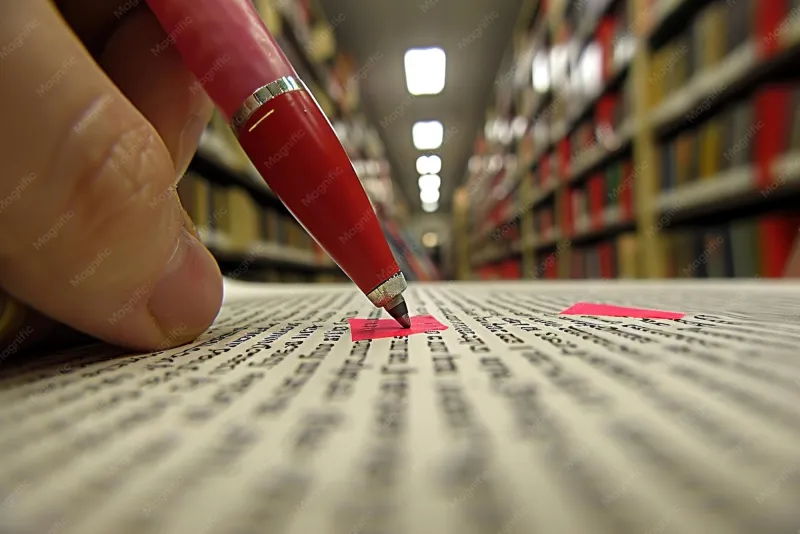
Photo: close-up of misprinted book page with red pen correction marks on a wooden desk, via img.freepik.com
Every small-press publisher carries a private nightmare. It is not bankruptcy, exactly, and it is not a bad review. It is the moment a reader emails a photograph of page 112 of a two-hundred-copy slipcased edition, circled in red, with a single question attached: Did you know?
The typo on a mass-market paperback is an embarrassment. The typo on a limited edition is something closer to a philosophical crisis — because the object was sold on the promise of permanence. A numbered run of 150, hand-sewn and foil-stamped, does not get a second printing. Whatever went to press is the edition, forever.
The Error That Cannot Be Unshipped
Consider the arithmetic. A boutique art book publisher in Portland — the kind that exhibits at MOCCA and Small Press Expo — spends eighteen months producing a retrospective of a cult cartoonist. The book sells out on pre-order. Then, three weeks after fulfillment, a collector on a forum notices that a famous panel has been reproduced mirror-flipped, reversing the lettering. The publisher has two options: reprint the entire signature page and hope the error stays quiet, or issue a public errata notice and watch the resale market react in real time.
Neither choice is painless. A reprint can cost more than the original print run if the edition included specialty materials that are no longer available. A public correction, meanwhile, converts a private flaw into a documented defect — and in the collectibles market, a documented defect is a price signal.
The Flaw Variant Phenomenon
And yet the market does not always punish the mistake. Numismatic collectors have long prized error coins — the 1955 doubled-die Lincoln cent is worth more than its flawless counterpart by orders of magnitude. The same logic has migrated, unevenly and unpredictably, into the book and print world.
Collectors have coined the term "flaw variant" for editions that shipped with acknowledged misprints: a misnumbered limitation page, a dust jacket with the illustrator's name misspelled, a first-run graphic novel with a duplicated word in a caption that became a running joke among fans. These copies occupy a strange position. They are objectively worse objects. They are also, in a narrow sense, rarer than the edition they belong to — a variant within a variant.
The distinction that matters is authorship of the flaw. An error the publisher acknowledges becomes part of the edition's history, almost a piece of provenance. An error the publisher hides becomes a trust liability when it surfaces anyway, which it invariably does. Collectors forgive mistakes; they do not forgive the pretense that no mistake occurred.
To Recall or to Let Stand
Publishers who have lived through this describe the decision as less strategic than ethical. A recall of a sold-out edition is functionally impossible — the copies are dispersed, many already resold, some already sealed in mylar. What publishers actually do is one of three things.
The first is the errata slip: a small, often elegantly printed correction card inserted into unsold copies and mailed to original buyers. Done well, the slip becomes a collectible in its own right; some collectors report that editions with errata slips feel more complete, the correction functioning as a final chapter.
The second is the corrected second state — a revised printing designated, honestly, as a second printing, with the flaw documented on the copyright page. This is the route most respected by bibliographers, who have spent a century cataloguing "points" that distinguish printings.
The third is silence. It is more common than anyone in the industry likes to admit, and it is the option that most reliably ends in the red-circled photograph arriving by email.
What the Flaw Teaches
There is an argument, made半 seriously at collector meetups, that the perfect edition is a slightly dead one — that the flaw is proof a human being assembled the object under deadline with finite money. The errata slip, in this reading, is not an apology but a signature: the publisher's hand, visible one last time.
Krem Editions exists on the premise that limitation is a feature of culture, not a bug in it. The flawed limited edition may be the purest expression of that premise. Two hundred copies exist. One of them is wrong in a way no other copy is wrong. The error is unrepeatable, unreproducible, and — once acknowledged — unforgettable.
Publishers facing the dilemma would do well to remember what the coin collectors learned long ago: the market does not reward perfection. It rewards stories, and few stories are better than the one where the maker stood up, pointed at the mistake, and said: yes. That one is ours.