Obsolete by Design: Why Dead Formats Are Now the Most Coveted Objects in the Room
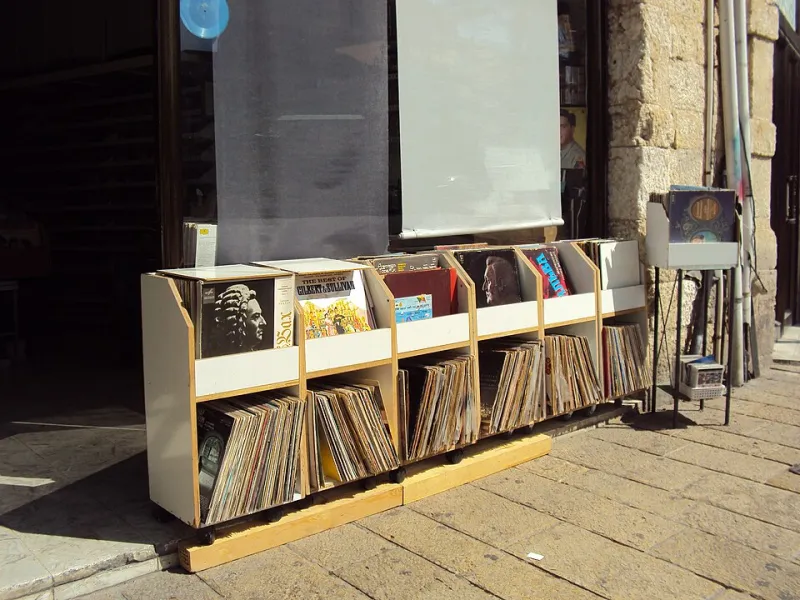
Photo: ביקורת, CC BY-SA 3.0, via Wikimedia Commons
There is a particular kind of irony embedded in the contemporary collector's shelf. Alongside limited-edition art books and signed graphic novels, you are increasingly likely to find a turntable, a cassette deck, and a stack of paperbacks whose spines have never been cracked by a digital algorithm. These are not antiques in the traditional sense. They are statements—deliberate, curated, and, in many cases, surprisingly expensive.
The resurrection of so-called dead media formats is one of the more counterintuitive cultural phenomena of the past decade. In an era defined by infinite streaming libraries, cloud-based reading platforms, and the promise that every piece of recorded human expression is accessible within seconds, a growing segment of the American public is choosing the harder, slower, more expensive alternative. They are doing so not out of ignorance, but out of conviction.
The Numbers Behind the Revival
The data is no longer ambiguous. According to the Recording Industry Association of America, vinyl record sales in the United States surpassed CD sales for the first time since the 1980s back in 2020—and the trend has only accelerated since. In 2023, vinyl generated over one billion dollars in revenue domestically. Cassette tape sales, though smaller in absolute terms, have grown for sixteen consecutive years. Independent bookstores, long eulogized by the publishing industry, have seen net new openings across major American cities throughout the early 2020s.
These are not niche footnotes. They represent a meaningful reallocation of cultural spending, and the demographics driving that spending are not who many expected. Buyers under thirty-five account for a disproportionate share of vinyl purchases. Many of them have no personal memory of a pre-digital media landscape. They did not grow up waiting for a cassette to rewind. They chose these formats anyway.
Nostalgia Without Memory
Traditional nostalgia marketing relies on a direct emotional connection—the consumer remembers the original experience and seeks to recapture it. What is happening with dead media formats is something more complex and, from a cultural standpoint, more interesting. Younger buyers are not reclaiming a past they lived through. They are constructing an imagined past that feels more authentic than the present they inherited.
This is what some cultural theorists have begun calling postmemory consumption: the adoption of objects and rituals from a prior era not because they are familiar, but because they carry the texture of authenticity that digital formats structurally cannot provide. A vinyl record requires physical handling, careful storage, and active attention. It resists multitasking. It insists on being the primary object in the room. In a media environment engineered to fracture attention and maximize passive consumption, that insistence feels radical.
The cassette, meanwhile, occupies a different register of meaning. Its lo-fi warmth, its association with mixtape culture and handwritten labels, makes it the format of intimacy and intention. Releasing music on cassette in 2025 is not a practical decision. It is an editorial one—a signal to the audience that the work inside warrants a different quality of attention.
Scarcity as Signal
Premium pricing is not incidental to the revival of physical formats. It is central to it. A standard vinyl pressing of a new album from an independent artist may retail for thirty to forty dollars. A limited-edition colored variant, pressed in a run of five hundred copies and available only through direct-to-fan channels, can command two or three times that figure—and sell out within hours.
This is the scarcity economy functioning at its most sophisticated. The object's value is not derived solely from its sonic or literary content. It is derived from its resistance to infinite reproduction. In a world where a digital file can be copied at zero marginal cost and distributed to every person on earth simultaneously, the object that cannot be so copied becomes precious by definition.
Collectors understand this instinctively. The limited pressing, the numbered edition, the hand-stamped sleeve—these are not mere marketing flourishes. They are the mechanisms by which physical media transforms from a delivery vehicle for content into a collectible artifact in its own right. The format becomes the product, and the product carries meaning that the content alone cannot generate.
The Algorithmic Counterreaction
There is a political dimension to this phenomenon that deserves acknowledgment. Streaming platforms, for all their convenience, operate on a logic of algorithmic mediation. The listener does not browse; they are guided. The reader does not discover; they are recommended to. The experience of cultural consumption is increasingly shaped by systems designed to maximize engagement metrics rather than to honor the integrity of individual works.
Physical media offers a genuine alternative to that architecture. The person who pulls a record from a crate in a Chicago shop on a Saturday afternoon is navigating by instinct, cover art, reputation, and chance. The experience is inefficient by every measurable standard. It is also irreplaceable. No recommendation engine has yet succeeded in replicating the quality of attention that physical browsing produces.
For a generation that has grown up inside algorithmic culture and developed a sophisticated awareness of its limitations, the choice to buy physical is partly an act of refusal. It is a decision to reclaim authorship over one's own cultural life—to be the curator rather than the curated.
Status, Substance, and the Collector's Shelf
It would be incomplete to discuss the revival of dead formats without acknowledging the role of status signaling. The well-appointed record collection, the thoughtfully assembled bookshelf, the cassette rack displayed in a home studio—these are legible markers of cultural seriousness in a way that a Spotify playlist or a Kindle library simply is not. Physical collections are visible. They communicate something about their owner to every visitor who enters the room.
This visibility has economic consequences. It drives demand for premium pressings, deluxe editions, and limited runs that justify display as much as use. It has also created a secondary market of considerable depth, in which first pressings and out-of-print editions trade for multiples of their original retail price.
What is most striking about the current moment is that obsolescence and desirability have become functionally synonymous for a specific class of objects. The format that was displaced by something more efficient did not disappear. It was reclassified—from commodity to collectible, from convenience to conviction. That reclassification is the engine of the resurrection economy, and there is no credible sign that it is slowing down.