Engineered Scarcity: How the Drop Economy Rewrote the Rules of Collecting

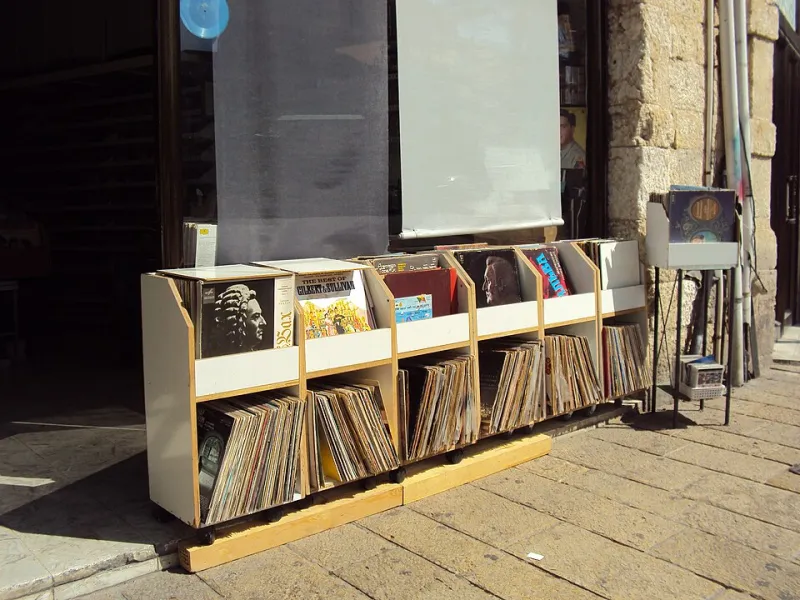
Photo: Matson Collection, Public domain, via Wikimedia Commons
There is a particular kind of anticipation that collectors know well. It arrives the night before a limited release—a quiet, almost ceremonial alertness. Alarm clocks are set. Browser tabs are pre-loaded. Notification settings are reviewed with the seriousness of pre-flight checklists. What was once the domain of record store queues and convention floor scrambles has migrated almost entirely to digital storefronts, where a product can sell through in under three minutes and reappear on a resale platform within the hour at three times the original price.
This is the drop economy. And it did not happen by accident.
The Architecture of Artificial Rarity
Scarcity, in its traditional form, was a consequence—of production costs, of distribution limitations, of modest initial demand. A first-edition art book from a small independent press was rare because the publisher could not afford to print more. A limited-edition screen print sold out because the artist had neither the infrastructure nor the intention to scale.
Today, scarcity is frequently a design choice rather than a constraint. Major entertainment brands, collectible publishers, and even mid-tier independent creators now deliberately cap production runs not at the ceiling of what they could produce, but at a threshold carefully calculated to ensure demand outpaces supply. The result is a release that is, almost by structural necessity, destined for the secondary market.
"The drop itself is the marketing," says one veteran of the sneaker and collectible art space who has consulted for several limited-edition publishing ventures. "You're not just selling the object. You're selling the event of trying to get the object. The resale price becomes a public metric of how successful that event was."
This logic has migrated with remarkable efficiency into the world of collectible publishing. Art books, numbered prints, and special-edition graphic novels now routinely deploy drop mechanics—timed releases, randomized allocation, exclusive retailer partnerships—borrowed wholesale from streetwear culture. The result is a secondary market that functions less like an afterthought and more like a second act of the original release strategy.
The Resale Platform as Cultural Barometer
Platforms such as eBay, StockX, and a growing constellation of niche collectible marketplaces have become, in effect, the price discovery engines for limited-edition culture. Where a publisher's suggested retail price represents an opening bid, the secondary market represents something closer to a consensus valuation—messy, speculative, and often wildly inflated, but undeniably real.
For some creators, these numbers function as validation. A limited art book that retails for sixty dollars and trades on the secondary market for two hundred is, by one interpretation, a work whose cultural resonance exceeded its initial commercial framing. The resale premium becomes a kind of critical endorsement, expressed not in review column inches but in dollars.
Others are considerably less comfortable with that framing. Several independent artists and small-press publishers have begun voicing concern that resale culture fundamentally redirects limited editions away from their intended audiences—the dedicated readers, the genuine fans, the collectors who would actually engage with the work—and toward a class of speculative buyers whose primary relationship with the object is financial.
"I make things for people who care about them," one independent graphic novelist told us. "When I see my books listed for resale the same week they ship, I feel like the distribution failed. The work ended up in the wrong hands."
Controlled Scarcity and the Counter-Movement
In response to these tensions, a cohort of creators has begun experimenting with what might be called controlled scarcity models—release strategies designed to preserve the cultural integrity of limited editions while limiting the opportunity for speculative extraction.
Some publishers now require proof of prior engagement—newsletter subscriptions, previous purchases, verified fan community membership—before a customer becomes eligible to purchase a new limited release. Others have implemented direct-to-collector sales that bypass traditional retail entirely, reducing the number of hands through which a product passes before reaching its intended owner. A small number of independent artists have experimented with price floors on resale, embedding contractual terms that limit the markup a secondary seller may legally apply.
None of these approaches is without friction. Eligibility requirements can feel exclusionary. Direct sales favor those with existing awareness of a creator's work. Resale price caps are notoriously difficult to enforce in practice. But the experimentation itself signals something significant: the creators most invested in limited-edition culture are increasingly unwilling to cede the secondary market to indifference.
Who Owns the Aftermarket?
The deeper question animating this conversation is one of cultural ownership. When a limited edition sells through and migrates to the secondary market, who—if anyone—retains meaningful authority over its meaning and circulation?
Resale platforms argue, with some justification, that they provide liquidity and access. Without a functioning secondary market, a collector who missed an initial drop has no legitimate path to ownership. The alternative—a world in which limited editions are permanently inaccessible to latecomers—serves neither creators nor audiences.
Creators, for their part, are beginning to assert that the aftermarket is not a neutral space but a continuation of their work's cultural life—one they have both a stake in and a responsibility toward. The rise of royalty-bearing smart contracts in digital collectibles has introduced at least one mechanism by which creators can participate financially in secondary sales, and the logic is beginning to influence conversations in the physical collectible space as well.
What remains clear is that the secondary market is no longer peripheral to limited-edition culture. It is, increasingly, central to it—a space where the values, contradictions, and ambitions of the drop economy are most nakedly on display. For collectors, creators, and publishers alike, understanding that space is no longer optional. It is the territory in which the future of collecting is being written, one transaction at a time.