Circulation as a Form of Praise: The Libraries Publishing Books No One Else Will
In the collecting world, wear is a flaw. A spine crease drops the value; a foxed page is a defect to be disclosed and discounted. But in a handful of American libraries, the opposite logic governs. There, a limited edition is judged successful not by how pristine it remains, but by how thoroughly it is destroyed — through use, through reading, through the slow abrasion of many hands.
A quiet movement is underway in which libraries — the institutions long cast as custodians of other people's publications — have taken up the publisher's mantle themselves.
The Publisher of Last Resort
Consider the position of the small-town librarian with a manuscript in hand. Perhaps it is a local poet's collected work, a regional historian's account of a flooded valley, a folktale cycle recorded from a now-deceased storyteller. Commercial publishers pass on such projects for understandable reasons: the audience is geographically bounded, the economics are unforgiving, the author has no platform. The manuscript is culturally significant and commercially invisible.
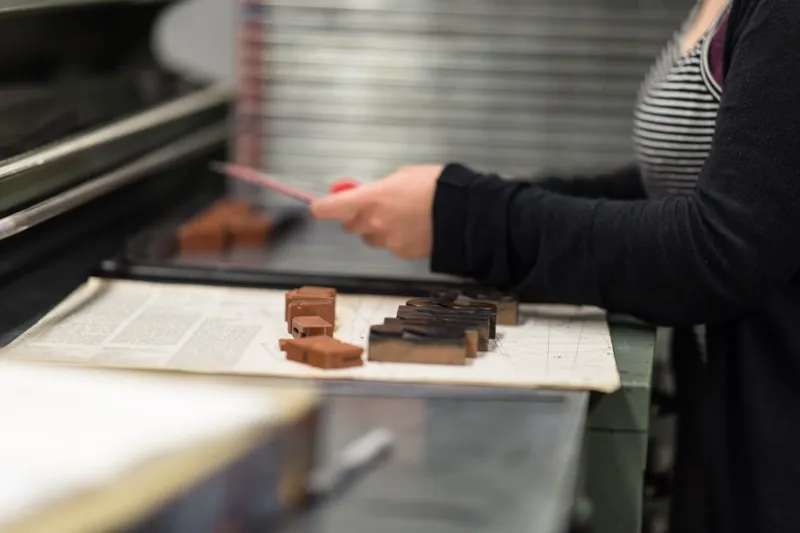
Libraries have begun filling that gap. Public libraries in the Midwest and New England, along with university presses' smaller cousins — special collections departments with discretionary funds — have commissioned letterpress editions, hand-bound chapbooks, and small-batch print runs of two hundred to five hundred copies. Some partner with regional fine presses; others operate their own press equipment, a vestige of the letterpress revival that never fully left the academic workshop.
What distinguishes these projects is that the library is not merely buying books. It is deciding what deserves to exist.
Scarcity, but Backwards
The limited edition as practiced by the commercial world is an instrument of exclusion. Numbered copies, sealed slipcases, certificates of authenticity — the apparatus exists to protect the object from the reader, to preserve the investment by preventing the experience.
The library model runs the machinery in reverse. These editions are made to circulate. A copy stamped with the institution's ownership mark, jacketed in mylar, and shelved in the local history section is not a store of value. It is a public asset whose purpose is fulfilled in the wearing.
Some institutions have formalized this philosophy. A few university special collections now acquire two copies of each commissioned edition: one archivally preserved, one designated a working copy that may be lent, photocopied, annotated by classes, and ultimately replaced. The replacement itself becomes evidence — a third printing of a book that only ever had two hundred copies, its existence proof that someone kept reading.
Collectors may find this heretical. It is closer to a correction. The rare book trade has always depended on survival against the odds — the survival of objects that were, in their own time, simply used. The library-commissioned edition produces that future survival honestly, by releasing books into circulation and letting attrition do its patient work.
What Gets Published When Nobody's Counting Sales
The catalogue of library-published work reveals what commercial logic excludes. Oral histories of shuttered mills and migrant labor camps. Bilingual editions of regional poetry. Facsimile reprints of diaries held in a single archival box. Genealogies of communities whose records exist nowhere else. One Midwestern county library spent three years producing an annotated edition of a settler's journal, letterpress printed with wood engravings by a local artist, in an edition of 300 — a book that no trade publisher would have priced sustainably and no reader outside the county would ever search for.
And that is precisely the point. These are editions whose justification is not demand but obligation. The library is the only institution whose mission includes both preservation and access, and when it publishes, it resolves the tension between them in a way no market actor can: it makes the scarce thing free to borrow.
The Collector's Dilemma, Reframed
For those of us who write about limited editions — who track print runs, numbering schemes, and the economics of scarcity — the library press presents an uncomfortable mirror. The objects we most celebrate are often the ones least likely to be read. The objects libraries publish are often the ones guaranteed to disappear.
Yet disappearance through use is not the same as loss. A well-loved library copy that survives forty years of circulation becomes, in its own way, a rare book — one whose provenance is not an auction house but a card pocket, a date stamp, a borrower's pencil mark in the margin. Those are the marks that fine-press collectors have traditionally sanded away. Libraries are betting they are the marks that matter.
There is a lesson here for the broader edition culture this site chronicles. Scarcity engineered for value produces objects that sit still. Scarcity engineered for access produces objects that move — and movement, as any archivist will tell you, is what culture is actually made of.
The librarian, it turns out, was never just a caretaker of books. In small towns and university basements across the country, she has become the last editor willing to say yes. The edition she produces may never appreciate in value. It may only appreciate in use. For a certain kind of reader, that is the more valuable appreciation — and the only one the library ever intended to keep.